Accounting
The Accounting module handles double-entry bookkeeping, covering all account types and operations required by law. Accounting entries are generated automatically from transactions in Purchasing, Sales, Inventory, Production and Payroll — significantly cutting operating time and the risk of errors. The module produces trial balances, journals, ledgers and annual financial statements in the legal format, and generates the tax declarations and the SAF-T file for ANAF.
Hover over a screenshot to see it straight, at full size.
What you can do
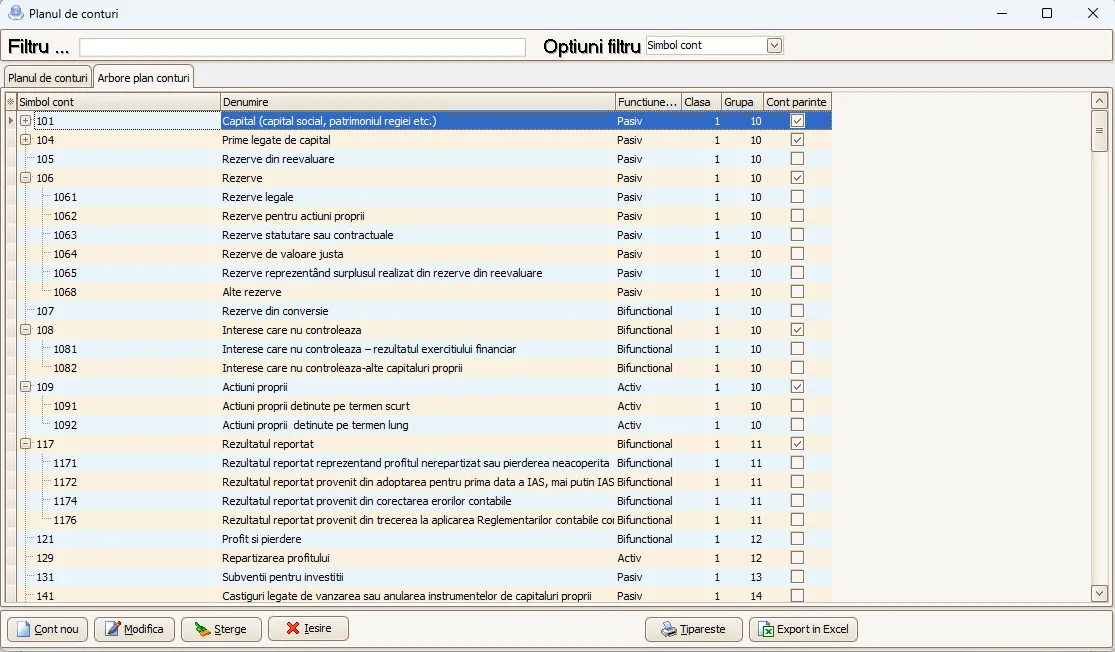
Section titled “What you can do”- Tree chart of accounts, fully configurable per regulations, adaptable to the company. Each account can be broken down into analytics, with settings for balance type, currency and posting usage.
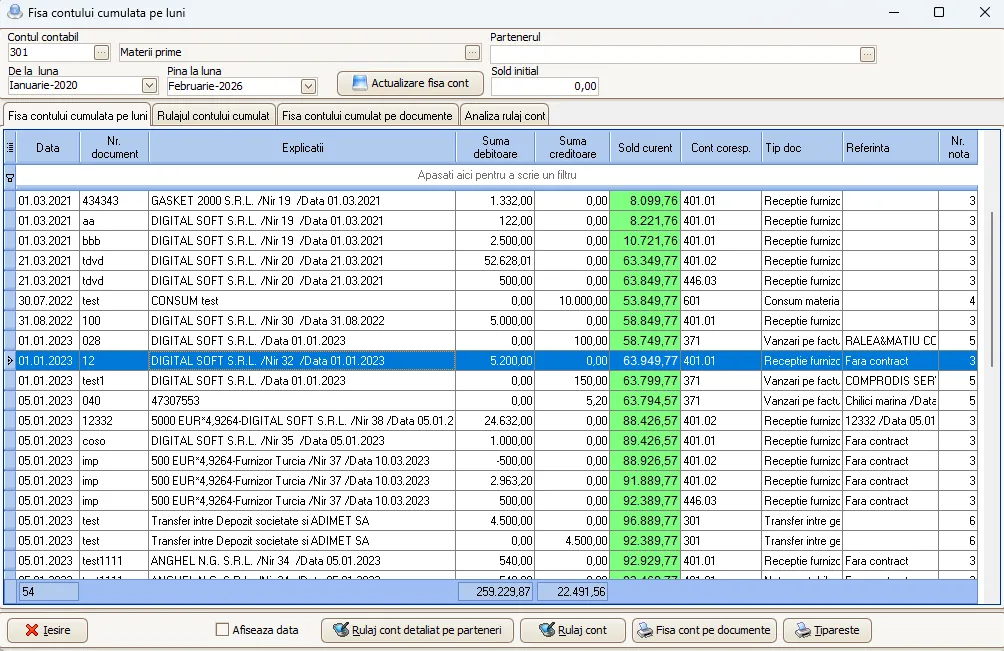
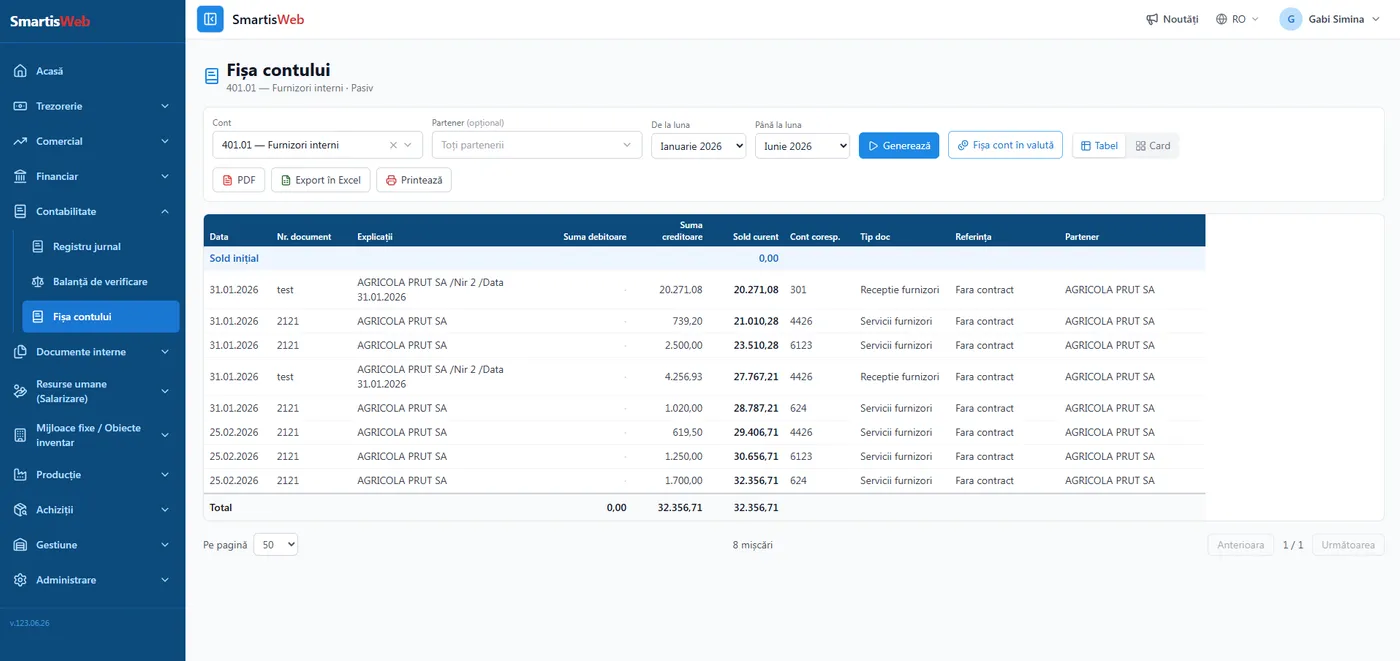
- Account ledger (monthly or cumulative), updated in real time from every module’s entries — debit, credit, intermediate balances and final balance, filterable by period, document or partner, with Excel/PDF export.
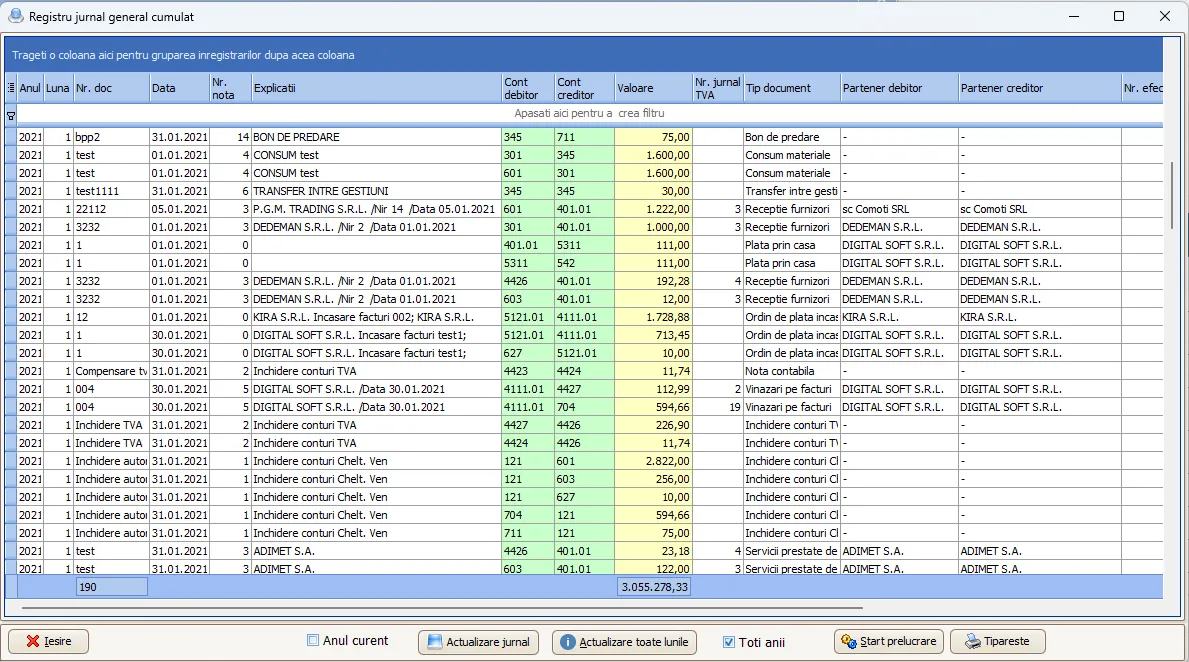
- Journal in the legal format, integrating all entries, exportable for official reporting.
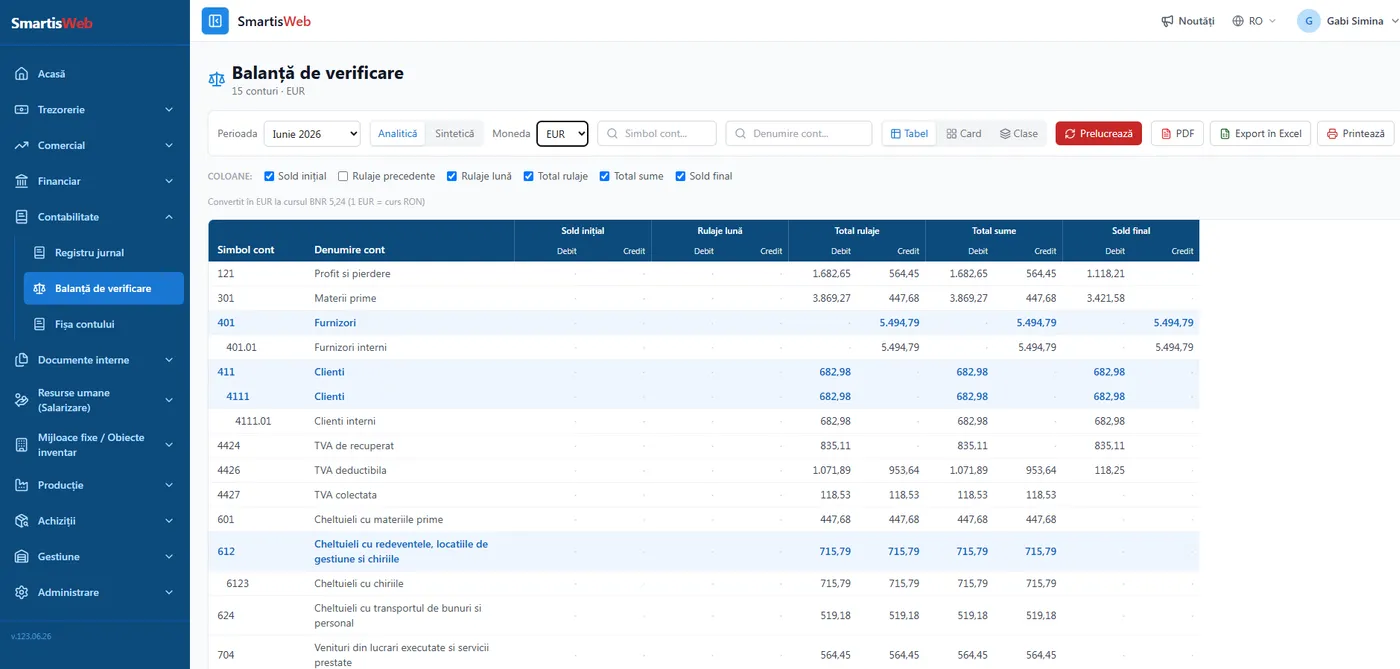
- Trial balance in local currency and FX, for any period — opening balances, movements and closing balances on synthetic and analytical accounts, with automatic currency conversion.
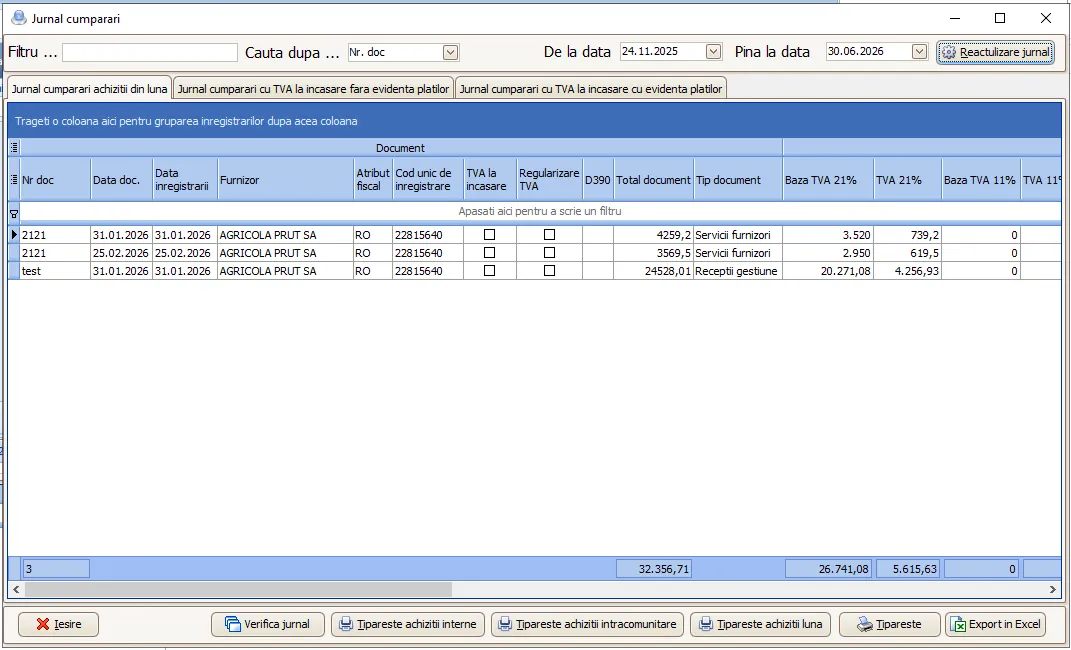
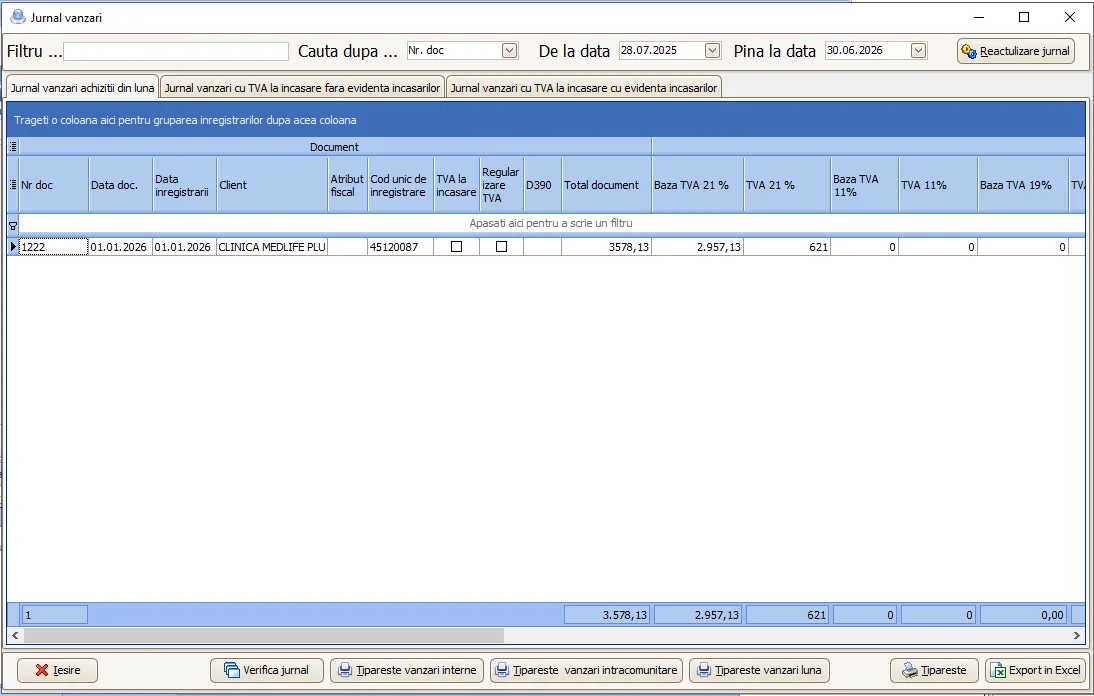
- Purchase and sales VAT ledgers generated automatically from Purchasing and Sales, filterable by period, partner, account and VAT code.
- FX differences computed and posted automatically (on collection/payment and at monthly revaluation).
- Accounting entries from templates and rules defined by the user, for consistent posting.
- EBITDA — a dedicated module, configurable to the company, with period reports (Excel/PDF export or in dashboards).
Account ledger
Section titled “Account ledger”The account ledger clearly shows debit, credit, intermediate balances and the final balance, generated in real time from every module’s entries, filterable by period, document or partner.
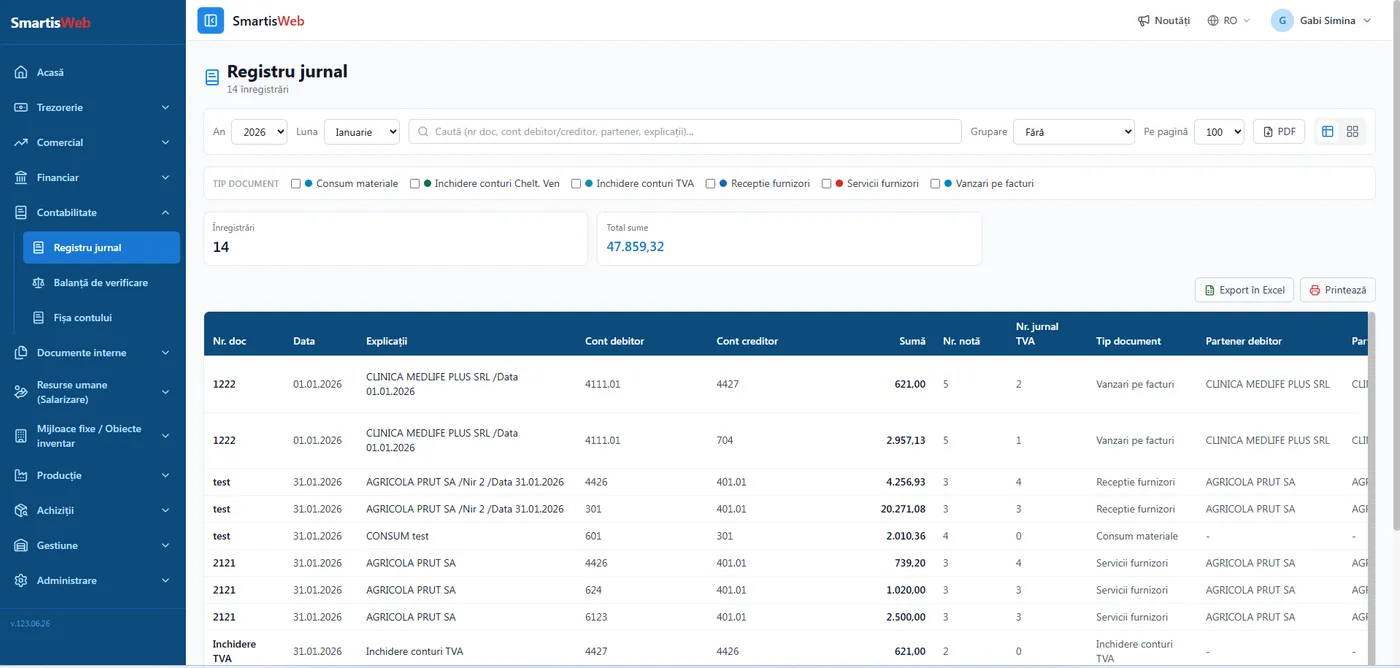
Journal
Section titled “Journal”All accounting entries, in chronological order, in the legal format — with debit/credit account, value, document type and partners.
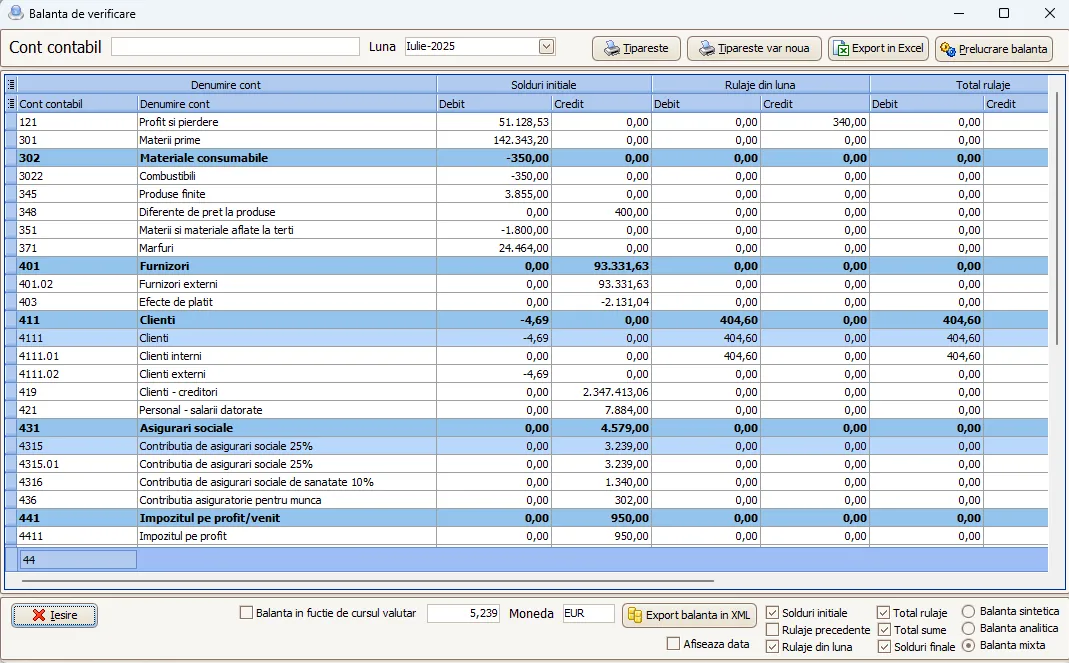
Trial balance
Section titled “Trial balance”The trial balance in local currency and FX, synthetic / analytical / mixed, for any period, with opening balances, movements and closing balances; currency conversion is automatic using the system’s rates.
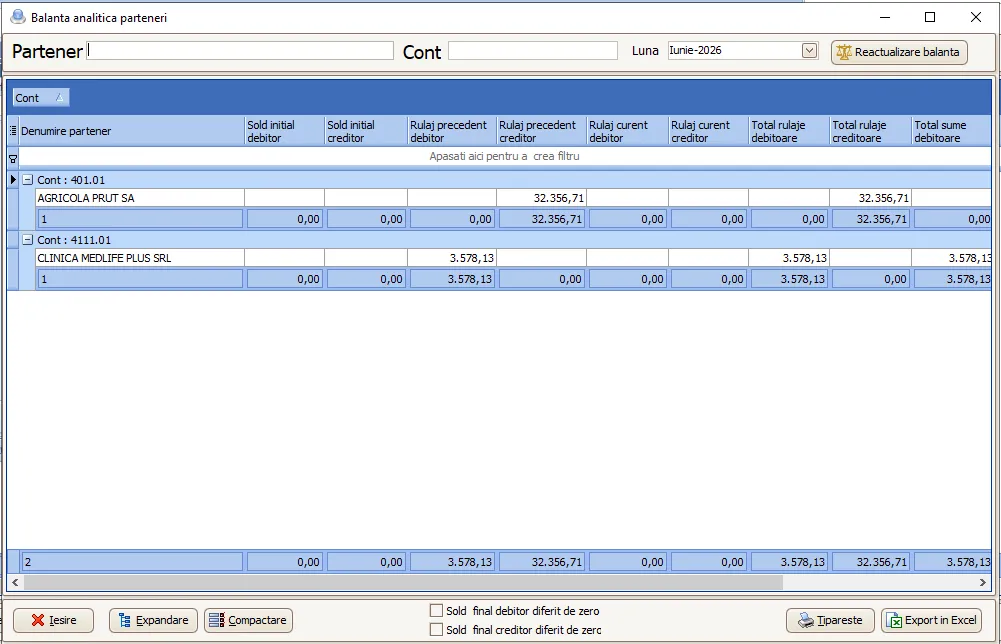
VAT ledgers
Section titled “VAT ledgers”The purchase and sales ledgers are generated automatically from the source documents, with VAT bases and rates, compliant with tax law.
Tax declarations and SAF-T (ANAF)
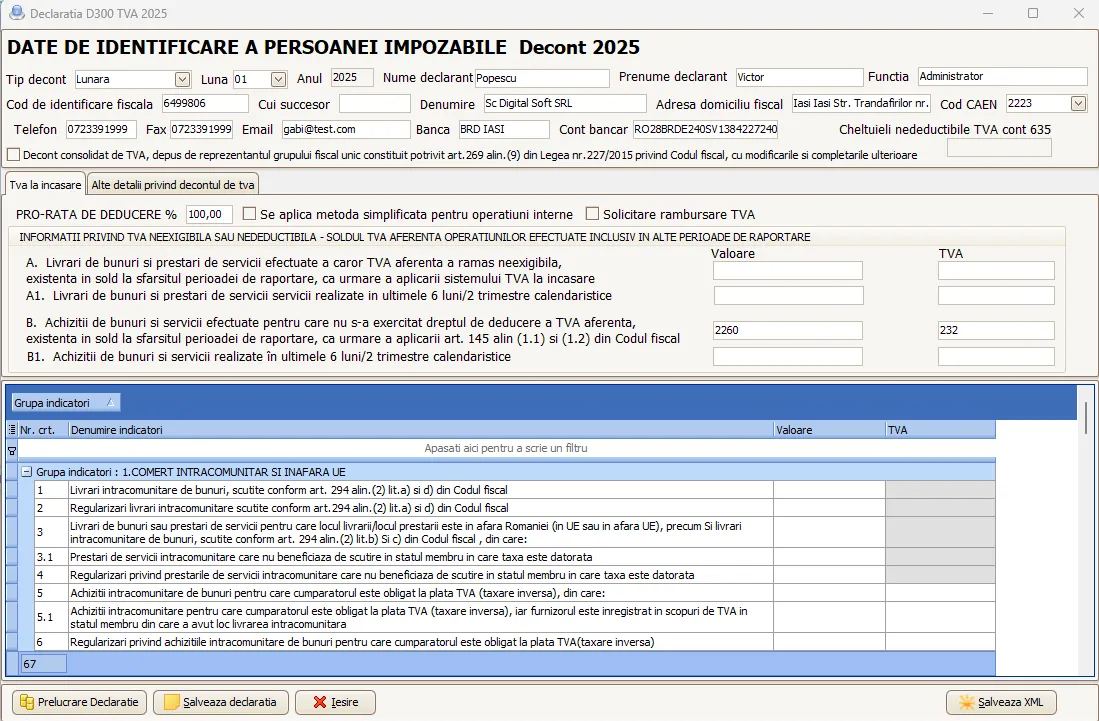
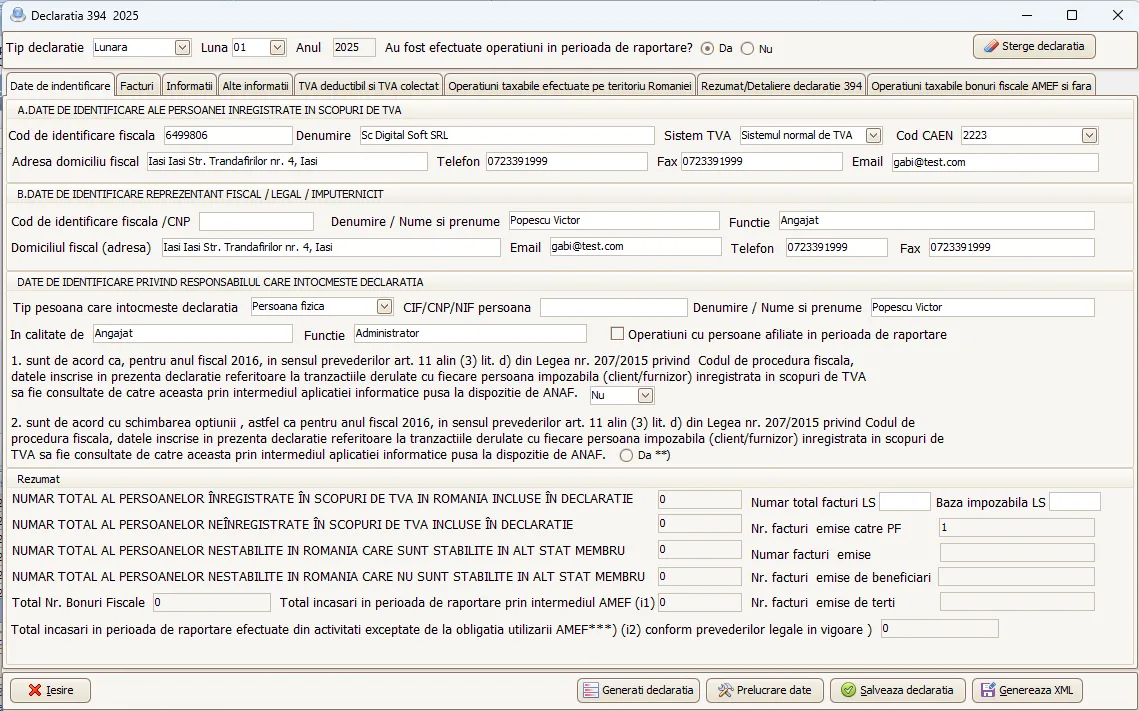
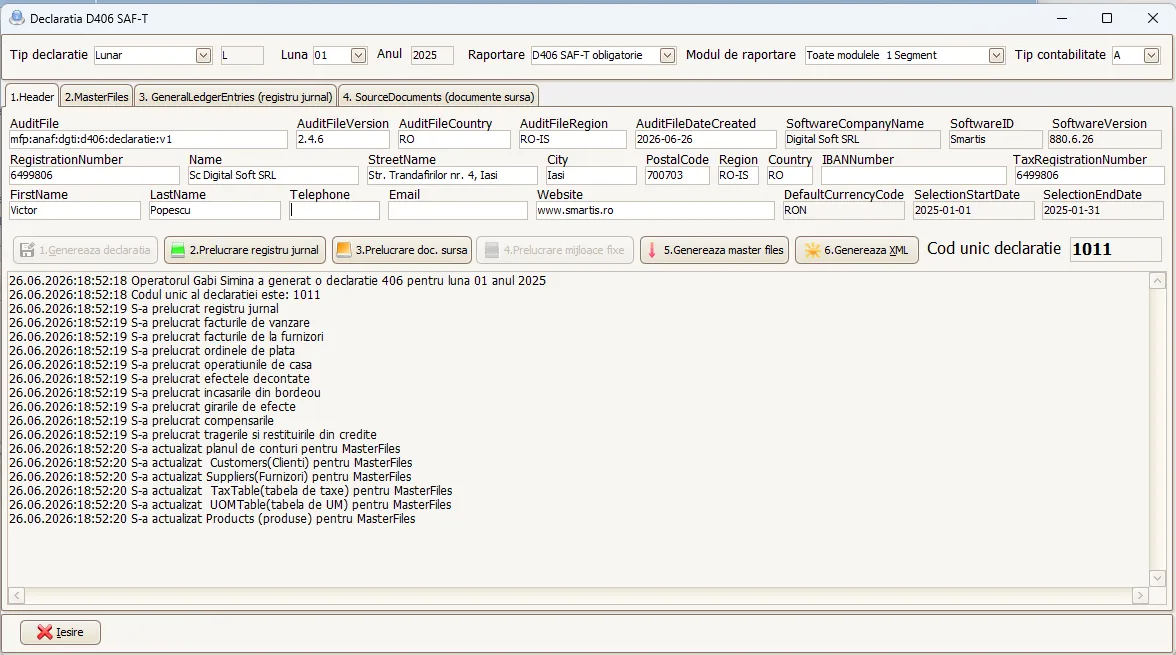
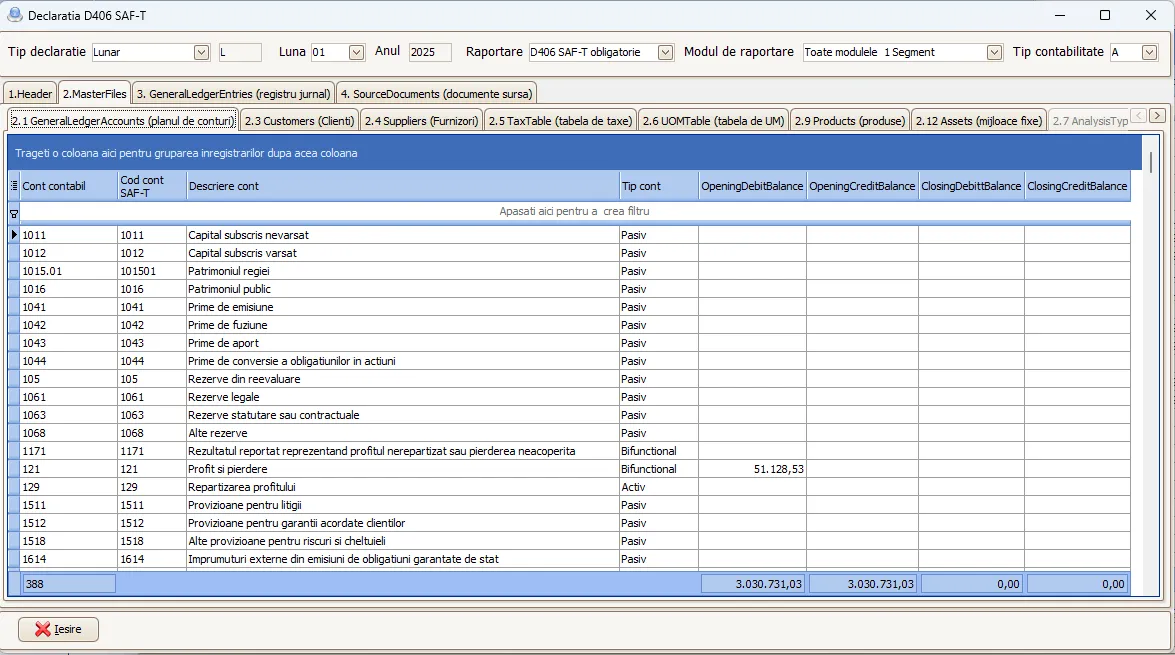
Section titled “Tax declarations and SAF-T (ANAF)”Generation and export for D300 (VAT return), D394, D390 (recapitulative), D100 and the SAF-T (D406) file — auto-filled from the ledgers and entries, compatible with the ANAF platform.
Reconciliation and consistency (the key to correctness)
Section titled “Reconciliation and consistency (the key to correctness)”Smartis automatically checks consistency across records, so the data is correct “by construction”:
- Trial balance ↔ P&L — the profit in the trial balance must equal the profit in the P&L, as must costs and revenue. That is exactly why the P&L shows complementary information taken from the trial balance (e.g. profit from account 121, output from 331, stock variation 7111). If the figures match, the P&L is correct.
- Trial balance ↔ production accounting (post-costing) — the total costs from the trial balance must equal those in the production-accounting journal. This guarantees that all costs are taken into account in post-costing and in determining work in progress and price differences.
These equality checks (trial balance = P&L, trial balance = production journal) are the “safety nets” confirming that the management reports and costs are correct.
Typical flow
Section titled “Typical flow”Operational documents (invoices, receipts, consumption, payroll, production) → automatic accounting entries (from templates) → account ledger / journal / trial balance → VAT ledgers → reconciliation (trial balance = P&L; trial balance = production journal) → tax declarations + SAF-T to ANAF.
Benefits
Section titled “Benefits”- Structured, compliant records, automatically integrated with every financial and operational process.
- Automatic accounting entries from all modules — no manual entry, minimal error risk.
- Real-time verification and reconciliation, with full support for local currency and FX.
- Full tax compliance (D300/D394/D390/D100, SAF-T) and electronic filing.
- EBITDA and the trial-balance ↔ P&L ↔ production reconciliations — decision support for management.
See the video tutorials or contact us for help.